Equalities, Human Rights and Civil Justice Committee
Annual Report of the Equalities, Human Rights and Civil Justice Committee for 2025-26
Introduction
This annual report covers the work of the Equalities, Human Rights and Civil Justice Committee during the Parliamentary year from 13 May 2025 to 8 April 2026.
Membership changes
The following changes to the Committee's membership occurred during the reporting period:
On 2 September 2025, Rhoda Grant replaced Paul O'Kane as a member of the Committee.
On 3 December 2025, Paul O'Kane replaced Rhoda Grant as a member of the Committee.
On 21 January 2026, Rhoda Grant replaced Paul O'Kane as a member of the Committee.
Meetings
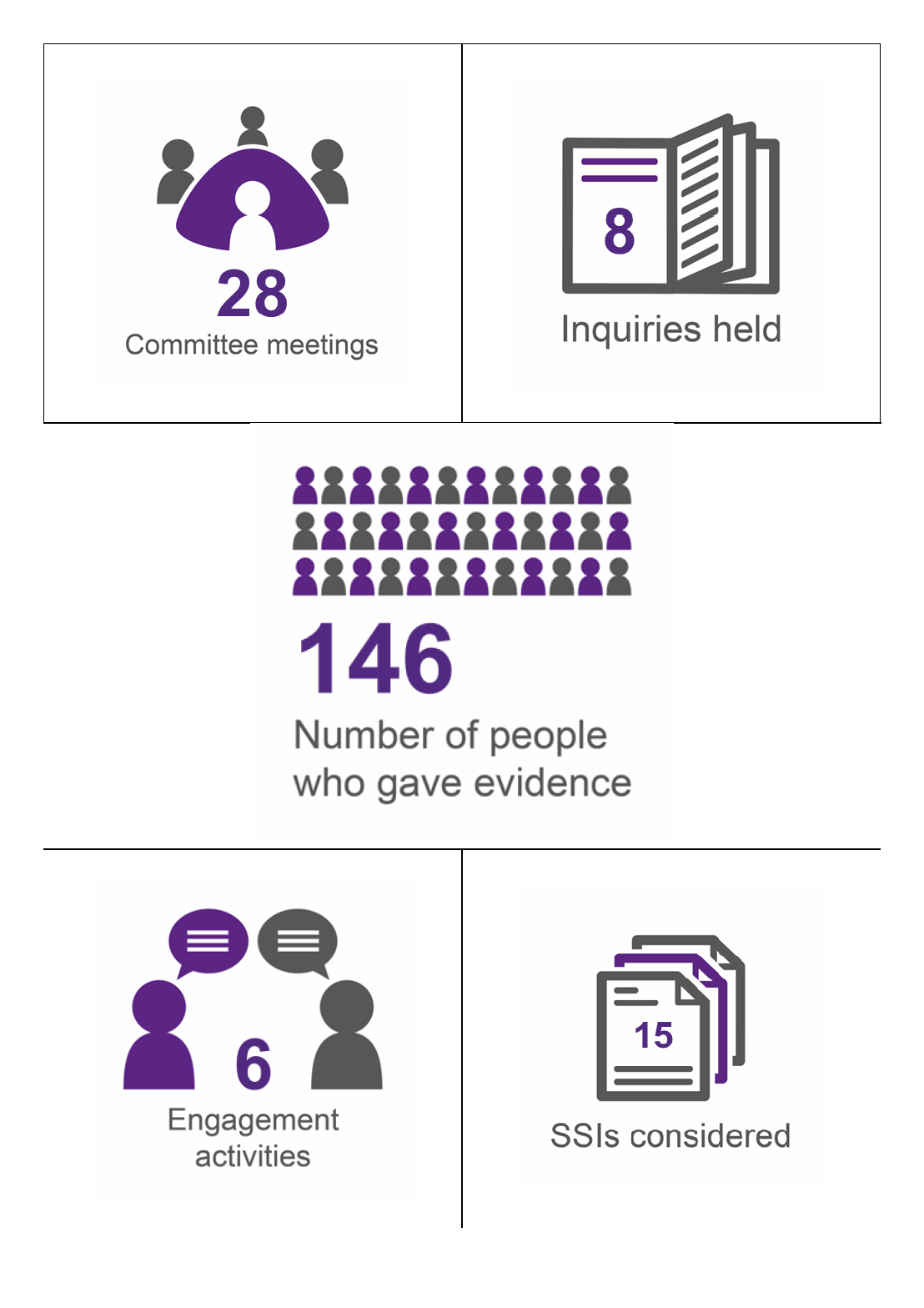
The Committee met a total of 28 times during the reporting period:
1 meeting was held entirely in public
3 meetings were held entirely in private
24 meetings included private items
The reasons for taking business in private were:
consideration of evidence
consideration of approach papers
consideration of correspondence
consideration of draft reports
consideration of the Committee's work programme.
In addition, the Committee held 6 informal, private engagement sessions and visits. These are highlighted later in the report.
Legislation
Bills
Disability Commissioner (Scotland) Bill
The Committee reported on the Disability Commissioner (Scotland) Bill at Stage 1 during the last reporting period. However, prior to the Stage 1 debate, the Bill was withdrawn by the Member in Charge, Jeremy Balfour MSP, on 30 September 2025, therefore no further scrutiny was undertaken by the Committee in this reporting period.
As the Bill had not yet completed Stage 1, Parliament was not required to agree to it being withdrawn.
Commissioner for Older People (Scotland) Bill
The Commissioner for Older People (Scotland) Bill was introduced by Colin Smyth MSP to the Scottish Parliament on 2 April 2025. The Bill was referred to this Committee for Stage 1 scrutiny.
Having agreed its approach to the scrutiny of the Bill at Stage 1 at its meeting on 24 June 20251, the Committee launched a call for views which ran from 26 June to 12 September 2025.
The Committee, however, agreed at its meeting on 9 September 2025 not to undertake any further work on the Bill.
Children (Withdrawal from Religious Education and Amendment of UNCRC Compatibility Duty) (Scotland) Bill
The Children (Withdrawal from Religious Education and Amendment of UNCRC Compatibility Duty) (Scotland) Bill is a Government Bill which was introduced by the Cabinet Secretary for Education and Skills on 30 April 2025. The Bill was referred to the Committee for Stage 1 scrutiny on 7 May 2025.
The Bill has two main purposes:
Part 1 of the Bill would require schools to inform a child if their parent asks for them to be withdrawn from either, or both, of religious education or religious observance;
Part 2 of the Bill provides an exemption to the United Nations Convention on the Rights of the Child (Incorporation) (Scotland) Act 2024 where public authorities are legally compelled to act incompatibly with UNCRC requirements due to provisions in Acts of the Scottish Parliament. The aim is to avoid any legislative conflicts.
Having agreed its approach to the scrutiny of the Bill at Stage 1 at its meeting on 17 June 20251, the Committee launched a call for views which ran from 20 June to 1 September 2025. Following publication of the responses received, the Committee held formal evidence sessions on 30 September 20252, 7 October 20253 and 28 October 20254, when it took its final evidence from the Cabinet Secretary for Education and Skills.
The Committee published its Stage 1 report on 19 November 20255. The response received from the Scottish Government was published on 24 November 20256.
The Stage 1 debate took place on 25 November 20257 and the Parliament agreed to the general principles of the Bill.
The Committee then considered the Bill at Stage 2 on 16 December 20258. The Stage 3 debate on the Bill took place in the Chamber on 17 February 20269, following which the Bill was passed.
Subordinate legislation
During the course of the reporting year, the Committee considered the following number of Scottish statutory instruments (SSIs):
6 SSIs subject to the affirmative procedure
9 SSIs subject to the negative procedure
Legislative Consent Memorandums
Border Security, Asylum and Immigration Bill
The Border Security, Asylum and Immigration Bill was introduced in the House of Commons on 30 January 2025. On 12 March 2025, the Cabinet Secretary for Social Justice subsequently lodged a legislative consent memorandum (LCM) which set out specific provisions for which the Scottish Government considered consent was required from the Scottish Parliament.
In summary, the Bill provisions were intended to expand the powers and capabilities of the police and other agencies in relation to both immigration offences specifically and serious crime more generally.
The Committee sought written views of stakeholders on the LCM and received three written responses:
COSLA1
Police Scotland2
Scottish Refugee Council3
The Committee reported in June 20254 and recommended that the Scottish Parliament consent to the UK Parliament legislating for the relevant provisions in this Bill. However, the Committee did note stakeholders' concerns about Clause 36 (provision of biometric information at ports in Scotland), and sought reassurance that the new process would not adversely affect vulnerable unaccompanied asylum-seeking children in Scotland.
Inquiries
Operation of the Public Sector Equality Duty
Having concluded evidence taking on its inquiry into the operation of the public sector equality duty in the previous reporting period, the Committee agreed to delay consideration of a draft report until it had reflected on the implications of the judgment in For Women Scotland Ltd (Appellant) v the Scottish Ministers (Respondent) on 16 April 20251.
The Committee agreed its report over two meetings in September 2025, and published The Operation of the Public Sector Equality Duty in Scotland report on 30 September. A response to the report was received from the Minister for Equalities on 16 December 2025.
Further to the report, the Committee took evidence from the Equality and Human Rights Commission (EHRC) and the Minister for Equalities, in two separate panels, on 13 January 20262.
Civil Legal Assistance
Following issuing a call for views on its inquiry into civil legal assistance in Scotland in the last reporting period, the Committee took evidence in May 2025 (131, 202 and 273 respectively). The focus of the inquiry was to consider:
what is working and not working within the current civil legal aid system; and
what changes could be made in the shorter and longer term to address issues about access to civil legal aid and the increasing challenges in finding a lawyer to take on such cases.
The Committee subsequently published its report on Civil Legal Assistance in Scotland on 17 September 2025 and received a response from the Minister for Victims and Community Safety on 24 November 2025. A debate on behalf of the Equalities, Human Rights and Civil Justice Committee was held in the Chamber on 6 January 20264.
The Minister for Victims and Community Safety committed to keep the Committee updated on progress towards legal aid reform. The Committee subsequently received a letter from the Minister for Victims and Community Safety on 28 January 2026 advising a draft Scottish Statutory Instrument had been laid in the Scottish Parliament providing for a 13% increase to legal aid and advice and assistance fees payable to solicitors.
A further letter was received from the Minister for Victims and Community on 23 February 2026 providing the Committee with an update on the progress of legal aid reform more generally.
The Committee took evidence on the Legal Aid and Advice and Assistance (Fees) Miscellaneous Amendment) (Scotland) Regulations 2026 [draft] from the Minister for Victims and Community Safety at its meeting on 24 February 20265, following which the draft regulations were recommended for approval by the Committee as confirmed in its report published on 24 February 20266.
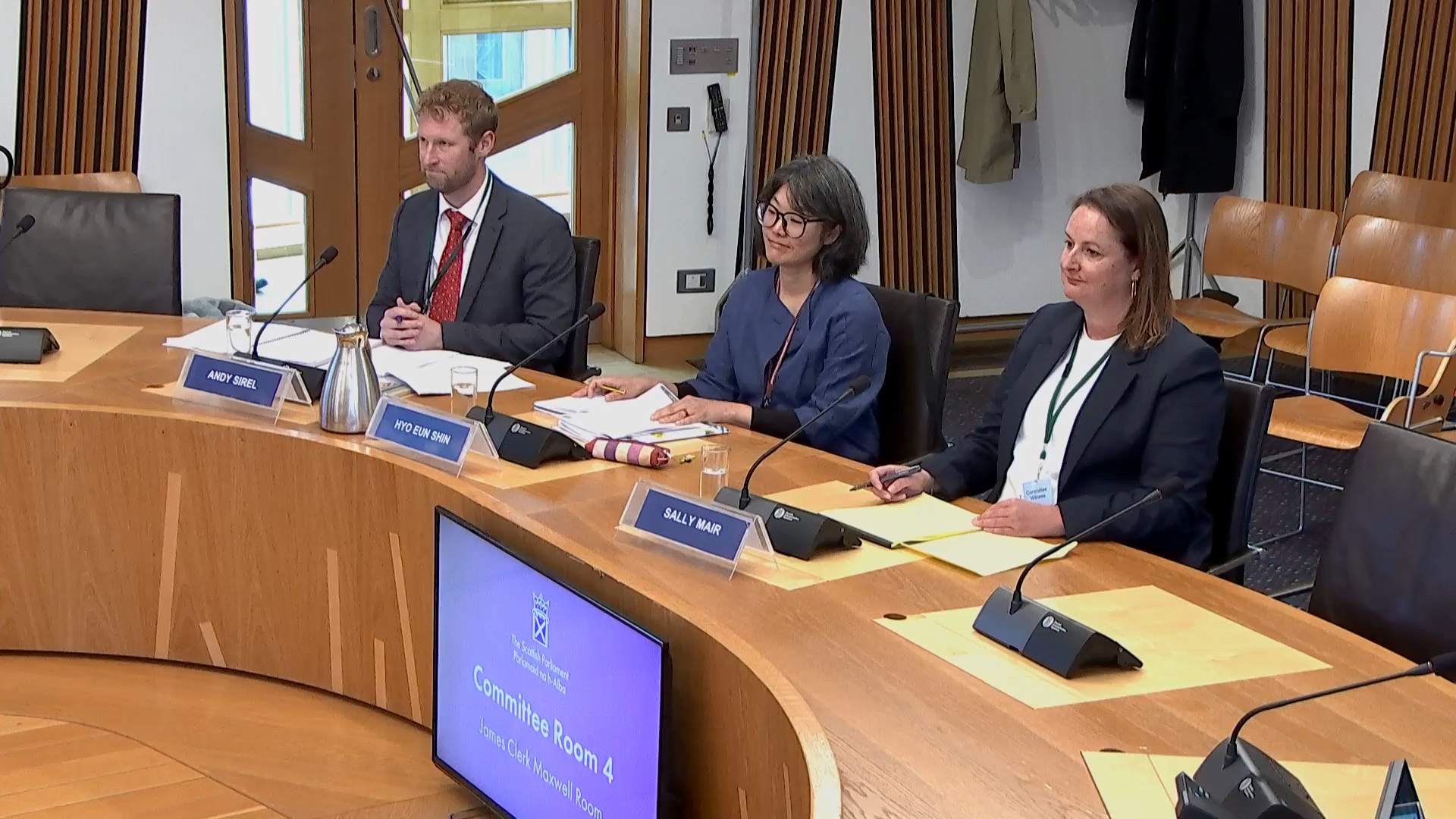
Second witness panel, 13 May 2025
Scottish Parliament
British Sign Language (Scotland) Act 2015
The Committee agreed at its meeting on 4 February 20251 to undertake a short inquiry on the British Sign Language (Scotland) Act 2015 and actions taken by the Scottish Government and public authorities listed under the Act to tackle barriers faced by British Sign Language (BSL) users in Scotland in the ten years since the Act received royal assent.
The Committee agreed to focus on:
Whether the BSL Act, the current BSL Plan and listed- authority plans were improving the lives of BSL users; and
What changes could be made in the shorter and longer term to improve the lives of BSL users in Scotland.
Prior to taking oral evidence, the Committee launched a call for views which ran from 3 April to 2 May 2025. The Committee then held formal evidence sessions over four separate panels which took place on 3 June 20252 and 17 June 20253. The Committee also undertook informal engagement sessions with BSL users as part of the inquiry. These are highlighted later in this report.
The Committee published its report on 27 September 2025. You can read the report on the British Sign Language (Scotland) Act 2015 or watch a BSL summary of the findings in the report.
The Deputy First Minister and Cabinet Secretary for Economy and Gaelic (the Deputy First Minister) responded to the report on 4 December 2025. You can read the Scottish Government's response or watch a BSL translation of it. The Committee held a follow-up session with the Deputy First Minister on 9 December 20254. A debate on behalf of the Equalities, Human Rights and Civil Justice Committee was held in the Chamber on 11 December 20255. The BSL interpretation of the debate is available on Scottish Parliament TV.
One particular area of focus during the inquiry was the impact of domestic abuse on BSL users. The Committee subsequently agreed to take evidence on this following the publication of a research report "Sign Loud: Perspectives on Deaf mothers and signing practitioners on domestic abuse, communication issues and the impact on Deaf families"6. The evidence session took place on 3 March 2026. As well as the Official Report of the meeting7, there is a BSL interpretation available on Scottish Parliament TV.
The Committee followed up from the evidence taken on 3 March and wrote to the Deputy First Minister on 5 March with questions and observations raised during the evidence session8.
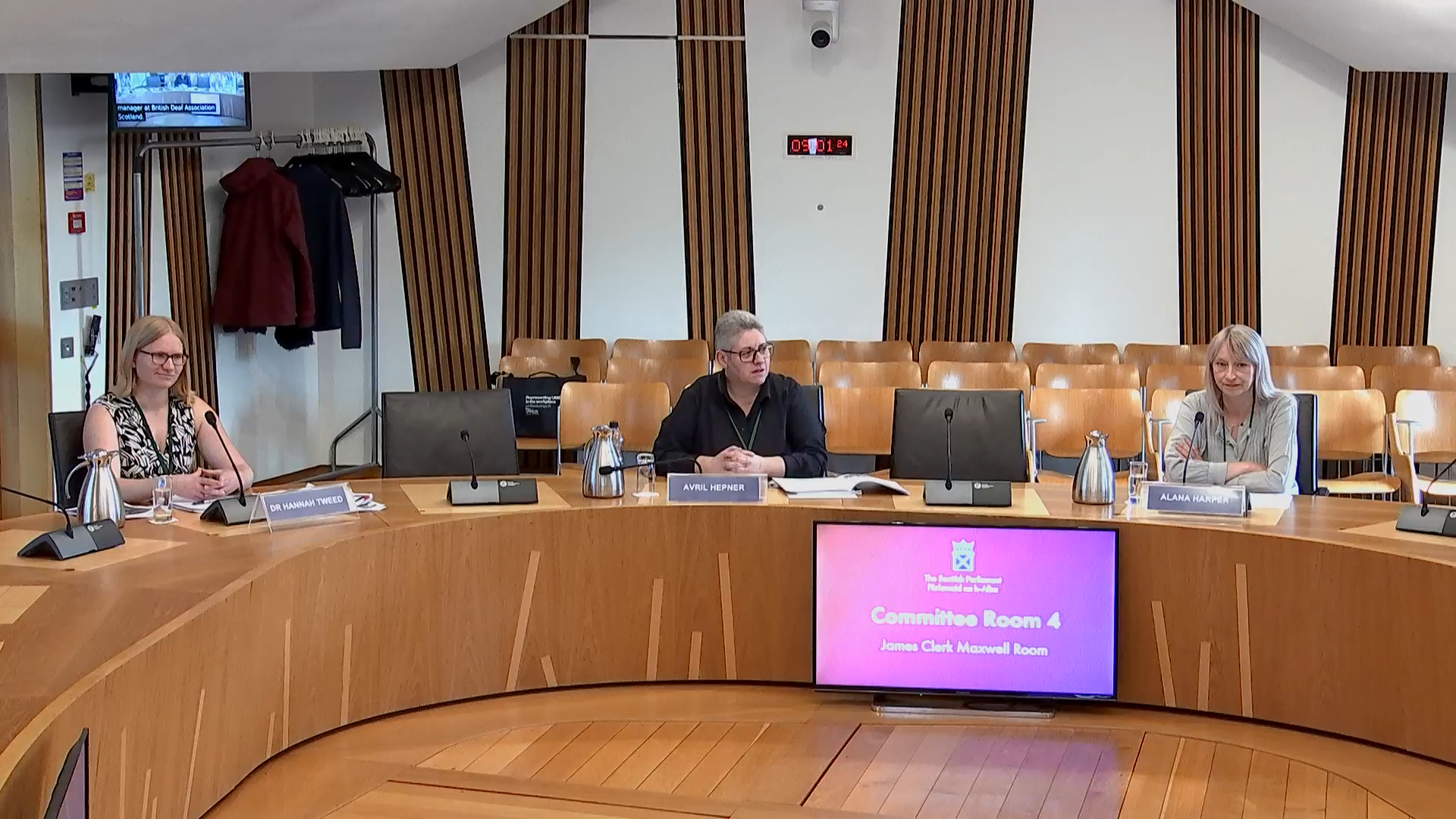
First witness panel, 3 June 2025
Scottish Parliament
Second witness panel, 3 June 2025

Scottish Parliament
Pre-Budget Scrutiny 2026-2027
This reporting year marked the final year of the Committee's session-long approach on human rights budgeting covering the three main principles of participation, transparency and accountability. This year's focus was on accountability.
The Committee has consistently recommended the mainstreaming of equalities and human rights budgeting across all Scottish Government portfolios and emphasised the importance of listening to lived experience. The focus on accountability brought together the Committee's scrutiny and public engagement over this Parliamentary session and enabled the Committee to revisit its collaborative approach with stakeholders.
Earlier in the session, the Committee worked with the Whole Family Equality Project to look at the budget from a citizen perspective. This year it returned to work with members of that group who had established the Commission Advocating Rights for Minorities (CARM). The Committee held an informal workshop with CARM which provided an opportunity to reflect on progress made by the Scottish Government in developing a human rights budgeting approach. It was also able to reflect with CARM on its approach to scrutiny, following which a number of conclusions and recommendations to the Scottish Government were co-produced by the Committee and CARM.
Informed by the session with CARM, the Committee held a roundtable session with key stakeholders it had worked with throughout the session to reflect on progress made this session. The Committee concluded its evidence taking by hearing from the Cabinet Secretary for Finance and Local Government and the Minister for Equalities. Both sessions took place on 9 September 20251.
The Committee published a report reflecting on the evidence this year as well as the session more generally. A response from the Scottish Government was received on 19 January 2026 following which the Committee held a further evidence session with the Cabinet Secretary for Finance and Local Government and the Minister for Equalities on 3 February 20262.
Human rights, equalities and access to services in rural areas of Scotland
A common thread running through much of the Committee’s work this session has been rurality. That is to say, the extent to which cross-cutting policy objectives are looked at with a view to equalities impacts in rural and island settings.
The Committee agreed at its meeting on 13 May 20251 to hold an inquiry to look at the main concerns regarding access to services and support in rural areas in contrast to those in urban areas.
The main reference point for the inquiry was the Scottish Human Rights Commission report from November 2024 on Economic, Social and Cultural Rights in the Highlands and Islands2.
The Committee then held formal evidence sessions on 18 November3 and 25 November 20254. The Committee also undertook an external engagement visit to Blairgowrie on 10 November 2025 and this is highlighted later in this report.
The Committee published its report on 20 February 2026.
Neurodivergence in Scotland
The Committee agreed at its meeting on 13 May 20251 to undertake an inquiry looking at the challenges facing neurodivergent people and the services for them in Scotland. This inquiry was originally informed by evidence sessions and lived experience engagement the Committee held in the previous reporting year on the Scottish Government's decision in 2024 to delay the introduction of a Learning Disabilities, Autism and Neurodivergence Bill.
A number of concerns were expressed to the Committee during these earlier sessions and the Committee agreed to take a focused approach on the experience of neurodivergent people in the following areas:
Education
Criminal Justice
Workplace
The Committee first took evidence from representatives of the Royal College of Psychiatrists in Scotland following publication in October 2025 of its report "Multi-system solutions for meeting the needs of autistic people and people with ADHD in Scotland"2.
The Committee then took formal evidence over four roundtables with stakeholders, which took place on 103 and 174 February, before having a final evidence session with the Minister for Social Care and Mental Wellbeing on 24 February5.
To help inform the inquiry, the Committee also undertook an informal visit and online engagement to hear from people with lived experience. These are highlighted later in this report.
The Committee published its report on 20 March 2026 and is available on the Committee reports webpage via the search function.
Roundtable witness, 10 February 2026

Scottish Parliament
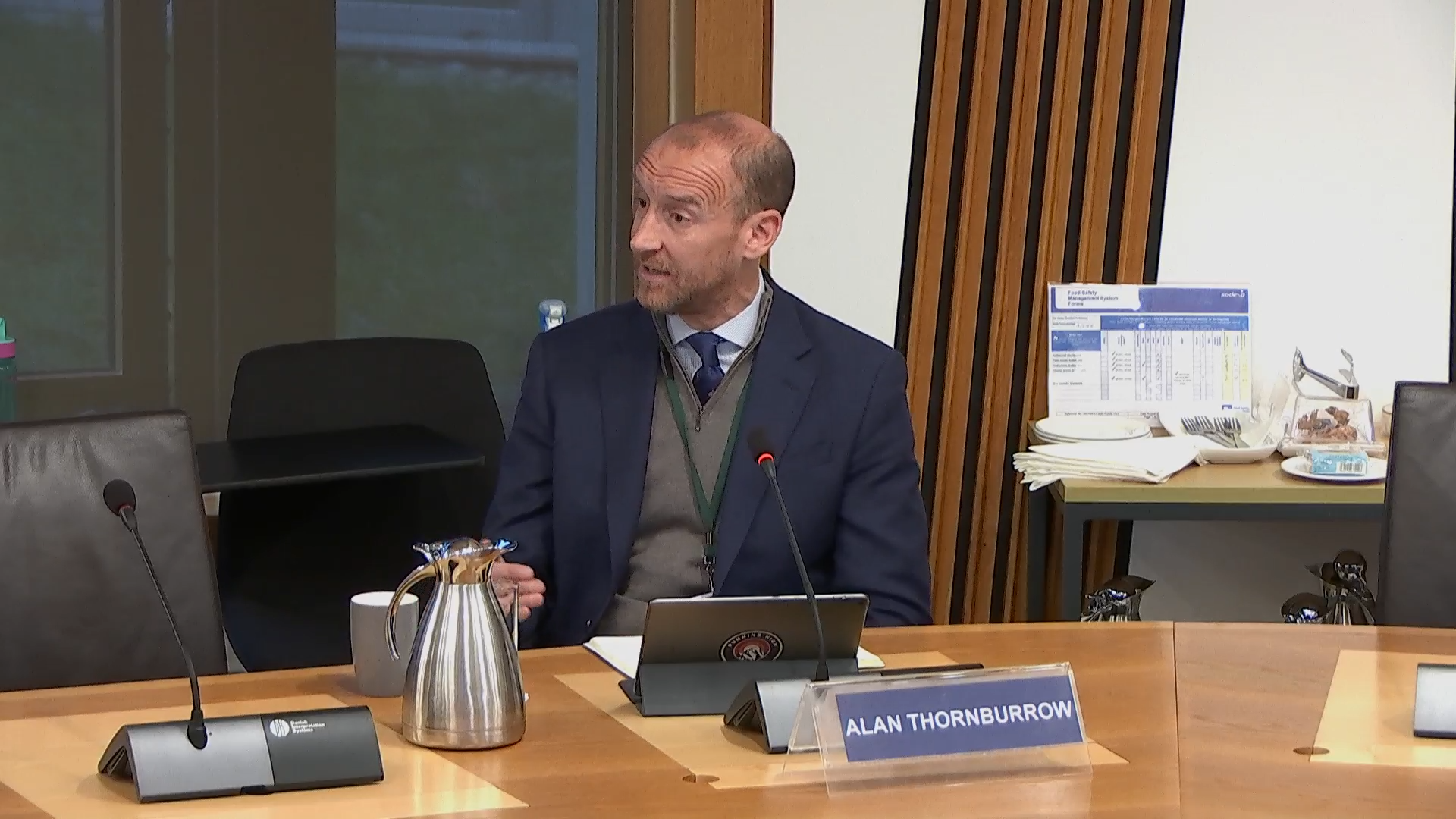
Roundtable witness, 10 February 2026
Scottish Parliament
International Covenant on Economic, Social and Cultural Rights (ICESCR)
The International Covenant on Economic, Social and Cultural Rights (ICESCR) is one of the core United Nations (UN) human rights treaties. The rights to work and fair treatment, adequate standard of living, health, education and social security apply to everyone without discrimination and member states have an obligation to respect, protect and fulfil them.
The Committee concluded evidence taking in the previous reporting period and wrote to the Scottish Government on 18 June 2025 seeking further information on Scotland's role in the UK's implementation of international human rights obligations regarding the Concluding Observations issued by the UN Committee on Economic, Social and Cultural Rights Observations (CESCR)1. The Committee received a response from the Minister for Equalities on 17 September 2025.
Following publication of the Scottish Government's High Level Action Plan in November 20252, which set out how it intends to respond to the Concluding Observations, the Committee held a further evidence session with the Minister for Equalities on 24 February 2026 on the Scottish Government's plans to strengthen the implementation of human rights in Scotland3. The session also looked at the Scottish Government's forthcoming digital Human Rights Tracker.
Non-Implementation of Acts
In this reporting year, the Committee continued its monitoring on the delay by the Scottish Government to implement all or some provisions within the following three Acts:
The Committee therefore held an evidence session with the relevant Scottish Government Ministers on 24 June 2025 in order to get a progress update on the individual Acts1.
Following the evidence session, the Committee issued a joint letter to the Minister for Equalities and the Minister for Victims and Community Safety requesting quarterly updates on progress in the implementation of the Acts2. The Committee subsequently received a joint response from the Minister for Equalities and the Minister for Victims and Community Safety on 26 September 20253.
However, in the absence of any further updates on progress, the Committee issued a joint letter to the Minister for Equalities and the Minister for Victims and Community Safety on 26 February 20264. The Committee received the following responses on 6 March:
Equalities, engagement and innovation
During this reporting period, the Committee continued to hear from people with lived experience to help inform its scrutiny and evidence. The Committee greatly values its relationship with stakeholders and other Scottish Parliament teams for the support, advice and assistance provided when organising and facilitating its engagement activities.
The Committee held six engagement sessions during the reporting period:
Two external fact-finding visits
Two informal sessions in the Scottish Parliament
Two online meetings focusing on lived experience.
The Committee would like to thank everyone involved who supported, facilitated and took part in all of these sessions. The importance of pre-planning and follow-up communications was also a crucial part of the engagement work. Without this level of collaboration, our engagement would not have been possible.
The Committee's first two informal engagement sessions were held on 9 and 10 June 2025 respectively to inform its British Sign Language (Scotland) Act 2025 inquiry.
On both occasions, the Committee met with BSL users from the British Deaf Association, Deaf Action and Deafblind Scotland to reflect on progress made since the Act was granted royal assent and to hear about the priorities and lived experiences of Deaf and deafblind people1.
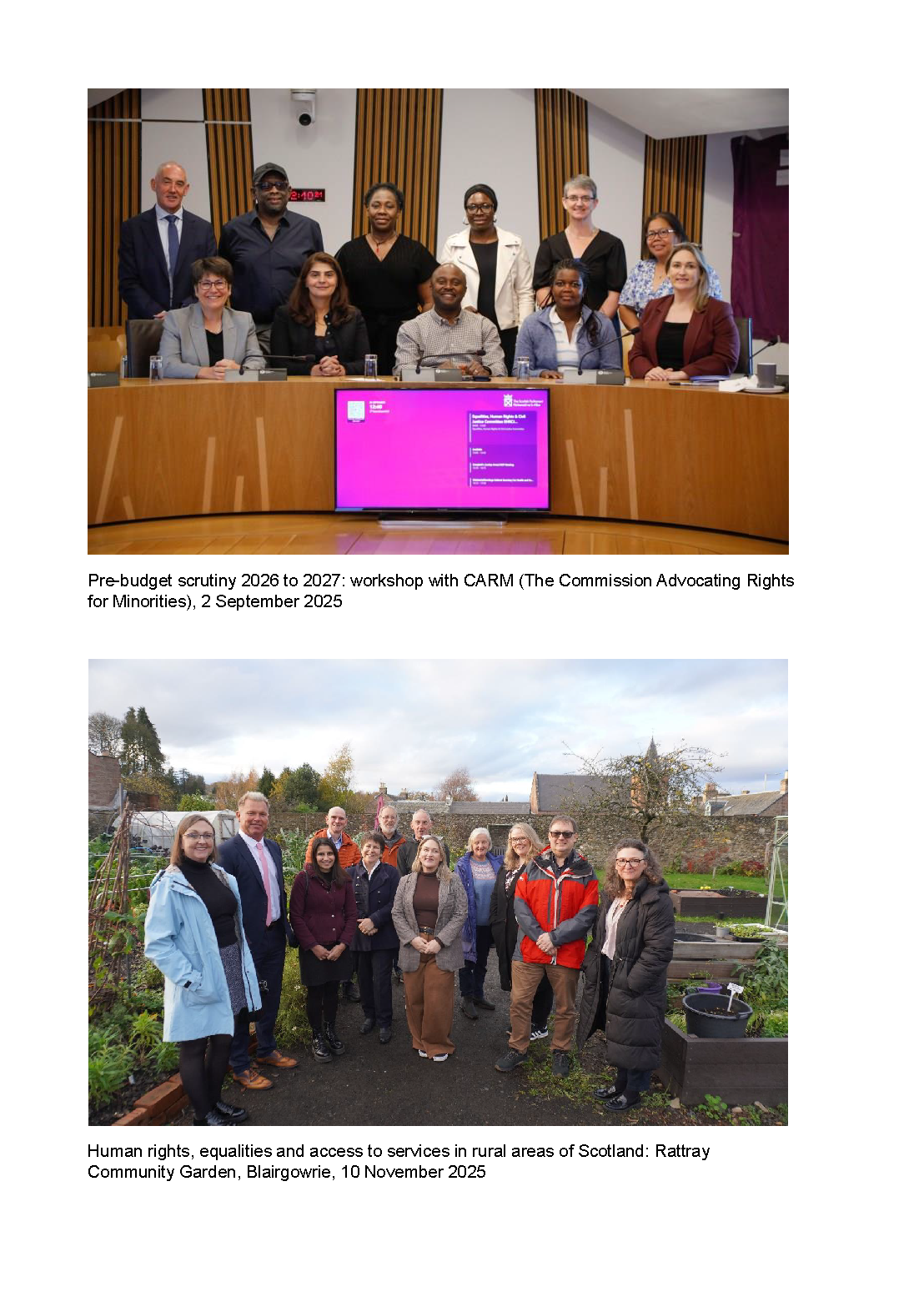
On 2 September 2025, the third engagement session was an informal workshop with the Commission Advocating Rights for Minorities (CARM) as part of the Committee's pre-budget scrutiny for 2026 to 2027.
The informal workshop started with a presentation from Dr Alison Hosie, Research Officer at the Scottish Human Rights Commission, on exploring the budget through the minimum core obligations. Following this, a joint exercise with CARM and Committee members focused on a case study from last year's Equality and Fairer Budget Scotland Statement.
In November, the Committee travelled to Blairgowrie for an external fact-finding visit to inform its inquiry into human rights, equalities and access to services in rural areas of Scotland to hear first-hand about the challenges people face.
This visit was supported and facilitated by Perth and Kinross Third Sector Interface and Perth and Kinross Association of Voluntary Services (PKAVS). Meetings were held at Wisecraft, a mental health and wellbeing support hub and Blairgowrie and Rattray Initiative (BARI). The day was completed with a visit to the Rattray Community Garden2.
The Committee's fifth and sixth engagement sessions took place in January and February 2026 as part of its inquiry into Neurodivergence in Scotland.
In January, Committee members visited Salvesen Mindroom Centre (Mindroom) in Edinburgh to hear from a range of employers and consultants. Mindroom works with organisations to raise awareness of neurodiversity and to support young people, families and workplaces.
On 9 February, Committee members held an online engagement session to hear from people with lived experience. This covered a number of concerns and issues faced by many in terms of assessments, diagnosis, attitudes and discrimination. Notes from the January and February engagement are linked below:
Infographic showing Committee statistics for the reporting year
Scottish Parliament
Sources
Scottish Parliament. (2025, June 24). Minutes of the Equalities, Human Rights and Civil Justice Committee. Retrieved from <a href="https://www.parliament.scot/chamber-and-committees/committees/current-and-previous-committees/session-6-equalities-human-rights-and-civil-justice-committee/meetings/2025/equalities-human-rights-and-civil-justice-committee-24-june-2025/minutes" target="_blank">https://www.parliament.scot/chamber-and-committees/committees/current-and-previous-committees/session-6-equalities-human-rights-and-civil-justice-committee/meetings/2025/equalities-human-rights-and-civil-justice-committee-24-june-2025/minutes</a>
Scottish Parliament. (2025, June 17). Minutes of the Equalities, Human Rights and Civil Justice Committee. Retrieved from <a href="https://www.parliament.scot/chamber-and-committees/committees/current-and-previous-committees/session-6-equalities-human-rights-and-civil-justice-committee/meetings/2025/equalities-human-rights-and-civil-justice-committee-17-june-2025/minutes" target="_blank">https://www.parliament.scot/chamber-and-committees/committees/current-and-previous-committees/session-6-equalities-human-rights-and-civil-justice-committee/meetings/2025/equalities-human-rights-and-civil-justice-committee-17-june-2025/minutes</a>
Scottish Parliament. (2025, September 30). Official Report of the Equalities, Human Rights and Civil Justice Committee. Retrieved from <a href="https://www.parliament.scot/chamber-and-committees/official-report/search-what-was-said-in-parliament/EHRCJ-30-09-2025?meeting=16612" target="_blank">https://www.parliament.scot/chamber-and-committees/official-report/search-what-was-said-in-parliament/EHRCJ-30-09-2025?meeting=16612</a>
Scottish Parliament. (2025, October 7). Official Report of the Equalities, Human Rights and Civil Justice Committee. Retrieved from <a href="https://www.parliament.scot/chamber-and-committees/official-report/search-what-was-said-in-parliament/EHRCJ-07-10-2025?meeting=16627" target="_blank">https://www.parliament.scot/chamber-and-committees/official-report/search-what-was-said-in-parliament/EHRCJ-07-10-2025?meeting=16627</a>
Scottish Parliament. (2025, October 28). Official Report of the Equalities, Human Rights and Civil Justice Committee. Retrieved from <a href="https://www.parliament.scot/chamber-and-committees/official-report/search-what-was-said-in-parliament/EHRCJ-28-10-2025?meeting=16640" target="_blank">https://www.parliament.scot/chamber-and-committees/official-report/search-what-was-said-in-parliament/EHRCJ-28-10-2025?meeting=16640</a>
Scottish Parliament. (2025, November 19). Stage 1 report on the Children (Withdrawal from Religious Education and Amendment of UNCRC Compatibility Duty) (Scotland) Bill. Retrieved from <a href="https://digitalpublications.parliament.scot/Committees/Report/EHRCJ/2025/11/19/8b21719d-e5fe-4428-be24-854910bbca1a#Introduction" target="_blank">https://digitalpublications.parliament.scot/Committees/Report/EHRCJ/2025/11/19/8b21719d-e5fe-4428-be24-854910bbca1a#Introduction</a>
Scottish Government. (2025, November 24). Letter from the Cabinet Secretary for Education and Skills to the Convener of the Equalities, Human Rights and Civil Justice Committee. Retrieved from <a href="https://www.parliament.scot/chamber-and-committees/committees/current-and-previous-committees/session-6-equalities-human-rights-and-civil-justice-committee/correspondence/2025/children-withdrawal-from-religious-education-24-november-2025" target="_blank">https://www.parliament.scot/chamber-and-committees/committees/current-and-previous-committees/session-6-equalities-human-rights-and-civil-justice-committee/correspondence/2025/children-withdrawal-from-religious-education-24-november-2025</a>
Scottish Parliament. (2025, November 25). Official Report of the Meeting of the Parliament. Retrieved from <a href="https://www.parliament.scot/chamber-and-committees/official-report/search-what-was-said-in-parliament/meeting-of-parliament-25-11-2025?meeting=16701&iob=142638" target="_blank">https://www.parliament.scot/chamber-and-committees/official-report/search-what-was-said-in-parliament/meeting-of-parliament-25-11-2025?meeting=16701&iob=142638</a>
Scottish Parliament. (2025, December 16). Official Report of the Equalities, Human Rights and Civil Justice Committee. Retrieved from <a href="https://www.parliament.scot/chamber-and-committees/official-report/search-what-was-said-in-parliament/EHRCJ-16-12-2025?meeting=16765" target="_blank">https://www.parliament.scot/chamber-and-committees/official-report/search-what-was-said-in-parliament/EHRCJ-16-12-2025?meeting=16765</a>
Scottish Parliament. (2026, February 17). Official Report of the Meeting of the Parliament. Retrieved from <a href="https://www.parliament.scot/chamber-and-committees/official-report/search-what-was-said-in-parliament/meeting-of-parliament-17-02-2026?meeting=20074&iob=205676" target="_blank">https://www.parliament.scot/chamber-and-committees/official-report/search-what-was-said-in-parliament/meeting-of-parliament-17-02-2026?meeting=20074&iob=205676</a>
COSLA. (2025, May 30). Submission to the Equalities, Human Rights and Civil Justice Committee from COSLA, 28 May 2025. Retrieved from <a href="https://www.parliament.scot/chamber-and-committees/committees/current-and-previous-committees/session-6-equalities-human-rights-and-civil-justice-committee/correspondence/2025/border-security-asylum-and-immigration-bill-lcm-cosla-28-may-2025" target="_blank">https://www.parliament.scot/chamber-and-committees/committees/current-and-previous-committees/session-6-equalities-human-rights-and-civil-justice-committee/correspondence/2025/border-security-asylum-and-immigration-bill-lcm-cosla-28-may-2025</a>
Police Scotland. (2025, May 30). Submission to the Equalities, Human Rights and Civil Justice Committee from Police Scotland, 27 May 2025. Retrieved from <a href="https://www.parliament.scot/chamber-and-committees/committees/current-and-previous-committees/session-6-equalities-human-rights-and-civil-justice-committee/correspondence/2025/border-security-asylum-and-immigration-bill-lcm-police-scotland-27-may-2025" target="_blank">https://www.parliament.scot/chamber-and-committees/committees/current-and-previous-committees/session-6-equalities-human-rights-and-civil-justice-committee/correspondence/2025/border-security-asylum-and-immigration-bill-lcm-police-scotland-27-may-2025</a>
Scottish Refugee Council. (2025, May 30). Submission to the Equalities, Human Rights and Civil Justice Committee from the Scottish Refugee Council, 27 May 2025. Retrieved from <a href="https://www.parliament.scot/chamber-and-committees/committees/current-and-previous-committees/session-6-equalities-human-rights-and-civil-justice-committee/correspondence/2025/border-security-asylum-and-immigration-bill-lcm-src-27-may-2025" target="_blank">https://www.parliament.scot/chamber-and-committees/committees/current-and-previous-committees/session-6-equalities-human-rights-and-civil-justice-committee/correspondence/2025/border-security-asylum-and-immigration-bill-lcm-src-27-may-2025</a>
Scottish Parliament. (2025, June 18). Equalities, Human Rights and Civil Justice Committee report on the Legislative Consent Memorandum (LCM) on the Border Security, Asylum and Immigration Bill. Retrieved from <a href="https://digitalpublications.parliament.scot/Committees/Report/EHRCJ/2025/6/18/22811fda-f723-471e-8f4a-2ac47b1e2856#Introduction" target="_blank">https://digitalpublications.parliament.scot/Committees/Report/EHRCJ/2025/6/18/22811fda-f723-471e-8f4a-2ac47b1e2856#Introduction</a>
UK Supreme Court. (2025, April 16). Judgment in For Women Scotland Ltd (Appellant) v The Scottish Ministers (Respondent). Retrieved from <a href="https://supremecourt.uk/cases/uksc-2024-0042" target="_blank">https://supremecourt.uk/cases/uksc-2024-0042</a>
Scottish Parliament. (2026). Official report of the Equalities, Human Rights and Civil Justice Committee. Retrieved from <a href="https://www.parliament.scot/chamber-and-committees/official-report/search-what-was-said-in-parliament/pa-13-01-2026?meeting=20014" target="_blank">https://www.parliament.scot/chamber-and-committees/official-report/search-what-was-said-in-parliament/pa-13-01-2026?meeting=20014</a>
Scottish Parliament. (2025). Official Report of the Equalities, Human Rights and Civil Justice Committee. Retrieved from <a href="https://www.parliament.scot/chamber-and-committees/official-report/search-what-was-said-in-parliament/EHRCJ-13-05-2025?meeting=16429" target="_blank">https://www.parliament.scot/chamber-and-committees/official-report/search-what-was-said-in-parliament/EHRCJ-13-05-2025?meeting=16429</a>
Scottish Parliament. (2025). Official Report of the Equalities, Human Rights and Civil Justice Committee. Retrieved from <a href="https://www.parliament.scot/chamber-and-committees/official-report/search-what-was-said-in-parliament/EHRCJ-20-05-2025?meeting=16442" target="_blank">https://www.parliament.scot/chamber-and-committees/official-report/search-what-was-said-in-parliament/EHRCJ-20-05-2025?meeting=16442</a>
Scottish Parliament. (2025, May 27). Official Report of the Equalities, Human Rights and Civil Justice Committee. Retrieved from <a href="https://www.parliament.scot/chamber-and-committees/official-report/search-what-was-said-in-parliament/EHRCJ-27-05-2025?meeting=16463" target="_blank">https://www.parliament.scot/chamber-and-committees/official-report/search-what-was-said-in-parliament/EHRCJ-27-05-2025?meeting=16463</a>
Scottish Parliament. (2026, January 6). Official Report of the Meeting of the Parliament. Retrieved from <a href="https://www.parliament.scot/chamber-and-committees/official-report/search-what-was-said-in-parliament/meeting-of-parliament-06-01-2026?meeting=16772&iob=143248" target="_blank">https://www.parliament.scot/chamber-and-committees/official-report/search-what-was-said-in-parliament/meeting-of-parliament-06-01-2026?meeting=16772&iob=143248</a>
Scottish Parliament. (2026, February 24). Official Report of the Equalities, Human Rights and Civil Justice Committee. Retrieved from <a href="https://www.parliament.scot/chamber-and-committees/official-report/search-what-was-said-in-parliament/EHRCJ-24-02-2026?meeting=20098" target="_blank">https://www.parliament.scot/chamber-and-committees/official-report/search-what-was-said-in-parliament/EHRCJ-24-02-2026?meeting=20098</a>
Scottish Parliament. (2026, February 24). Equalities, Human Rights and Civil Justice Committee: Report on the Legal Aid and Advice and Assistance (Fees) (Miscellaneous Amendment) (Scotland) Regulations 2026 [draft]. Retrieved from <a href="https://digitalpublications.parliament.scot/Committees/Report/EHRCJ/2026/2/24/7cfe50b5-0567-48e2-9f0c-bfd4386a55b0#Introduction" target="_blank">https://digitalpublications.parliament.scot/Committees/Report/EHRCJ/2026/2/24/7cfe50b5-0567-48e2-9f0c-bfd4386a55b0#Introduction</a>
Scottish Parliament. (2025, February 4). Meeting of the Equalities, Human Rights and Civil Justice Committee. Retrieved from <a href="https://www.parliament.scot/chamber-and-committees/committees/current-and-previous-committees/session-6-equalities-human-rights-and-civil-justice-committee/meetings/2025/equalities-human-rights-and-civil-justice-committee-04-february-2025/minutes" target="_blank">https://www.parliament.scot/chamber-and-committees/committees/current-and-previous-committees/session-6-equalities-human-rights-and-civil-justice-committee/meetings/2025/equalities-human-rights-and-civil-justice-committee-04-february-2025/minutes</a>
Scottish Parliament. (2025, June 3). Official Report of the Equalities, Human Rights and Civil Justice Committee. Retrieved from <a href="https://www.parliament.scot/chamber-and-committees/official-report/search-what-was-said-in-parliament/EHRCJ-03-06-2025?meeting=16483" target="_blank">https://www.parliament.scot/chamber-and-committees/official-report/search-what-was-said-in-parliament/EHRCJ-03-06-2025?meeting=16483</a>
Scottish Parliament. (2025, June 17). Official Report of the Equalities, Human Rights and Civil Justice Committee. Retrieved from <a href="https://www.parliament.scot/chamber-and-committees/official-report/search-what-was-said-in-parliament/EHRCJ-17-06-2025?meeting=16512" target="_blank">https://www.parliament.scot/chamber-and-committees/official-report/search-what-was-said-in-parliament/EHRCJ-17-06-2025?meeting=16512</a>
Scottish Parliament. (2025, December 9). Official Report of the Equalities, Human Rights and Civil Justice Committee. Retrieved from <a href="https://www.parliament.scot/chamber-and-committees/official-report/search-what-was-said-in-parliament/EHRCJ-09-12-2025?meeting=16756" target="_blank">https://www.parliament.scot/chamber-and-committees/official-report/search-what-was-said-in-parliament/EHRCJ-09-12-2025?meeting=16756</a>
Scottish Parliament. (2025, December 11). Official Report of the Meeting of the Parliament. Retrieved from <a href="https://www.parliament.scot/chamber-and-committees/official-report/search-what-was-said-in-parliament/meeting-of-parliament-11-12-2025?meeting=16744&iob=143050" target="_blank">https://www.parliament.scot/chamber-and-committees/official-report/search-what-was-said-in-parliament/meeting-of-parliament-11-12-2025?meeting=16744&iob=143050</a>
Heriot-Watt University and the University of Edinburgh. (2025). Sign Loud: Perspectives of Deaf mothers and signing practitioners on domestic abuse, communication issues and the impact on Deaf families. Retrieved from <a href="https://signs.hw.ac.uk/wp-content/uploads/Sign-LOUD-Exec-summary-pdf-final.pdf" target="_blank">https://signs.hw.ac.uk/wp-content/uploads/Sign-LOUD-Exec-summary-pdf-final.pdf</a>
Scottish Parliament. (2026, March 3). Official Report of the Equalities, Human Rights and Civil Justice Committee. Retrieved from <a href="https://www.parliament.scot/chamber-and-committees/official-report/search-what-was-said-in-parliament/EHRCJ-03-03-2026?meeting=20118" target="_blank">https://www.parliament.scot/chamber-and-committees/official-report/search-what-was-said-in-parliament/EHRCJ-03-03-2026?meeting=20118</a>
Scottish Parliament. (2026, March 5). Letter to the Deputy First Minister and Cabinet Secretary for Economy and Gaelic. Retrieved from <a href="https://www.parliament.scot/chamber-and-committees/committees/current-and-previous-committees/session-6-equalities-human-rights-and-civil-justice-committee/correspondence/2026/british-sign-language-sign-loud-report-5-march-2026" target="_blank">https://www.parliament.scot/chamber-and-committees/committees/current-and-previous-committees/session-6-equalities-human-rights-and-civil-justice-committee/correspondence/2026/british-sign-language-sign-loud-report-5-march-2026</a>
Scottish Parliament. (2025, September 9). Official Report of the Equalities, Human Rights and Civil Justice Committee. Retrieved from <a href="https://www.parliament.scot/chamber-and-committees/official-report/search-what-was-said-in-parliament/EHRCJ-09-09-2025?meeting=16567" target="_blank">https://www.parliament.scot/chamber-and-committees/official-report/search-what-was-said-in-parliament/EHRCJ-09-09-2025?meeting=16567</a>
Scottish Parliament. (2026, February 3). Official Report of the Equalities, Human Rights and Civil Justice Committee. Retrieved from <a href="https://www.parliament.scot/chamber-and-committees/official-report/search-what-was-said-in-parliament/EHRCJ-03-02-2026?meeting=20058" target="_blank">https://www.parliament.scot/chamber-and-committees/official-report/search-what-was-said-in-parliament/EHRCJ-03-02-2026?meeting=20058</a>
Scottish Parliament. (2025, May 13). Minutes of the Equalities, Human Rights and Civil Justice Committee. Retrieved from <a href="https://www.parliament.scot/chamber-and-committees/committees/current-and-previous-committees/session-6-equalities-human-rights-and-civil-justice-committee/meetings/2025/equalities-human-rights-and-civil-justice-committee-13-may-2025/minutes" target="_blank">https://www.parliament.scot/chamber-and-committees/committees/current-and-previous-committees/session-6-equalities-human-rights-and-civil-justice-committee/meetings/2025/equalities-human-rights-and-civil-justice-committee-13-may-2025/minutes</a>
Scottish Human Rights Commission. (2024, November). Economic, Social and Cultural Rights in the Highlands and Islands. Retrieved from <a href="https://www.scottishhumanrights.com/media/2884/main-report_economic-social-and-cultural-rights-in-the-highlands-and-islands.pdf" target="_blank">https://www.scottishhumanrights.com/media/2884/main-report_economic-social-and-cultural-rights-in-the-highlands-and-islands.pdf</a>
Scottish Parliament. (2025, November 18). Official Report of the Equalities, Human Rights and Civil Justice Committee. Retrieved from <a href="https://www.parliament.scot/chamber-and-committees/official-report/search-what-was-said-in-parliament/EHRCJ-18-11-2025?meeting=16702" target="_blank">https://www.parliament.scot/chamber-and-committees/official-report/search-what-was-said-in-parliament/EHRCJ-18-11-2025?meeting=16702</a>
Scottish Parliament. (2025, November 25). Official Report of the Equalities, Human Rights and Civil Justice Committee. Retrieved from <a href="https://www.parliament.scot/chamber-and-committees/official-report/search-what-was-said-in-parliament/EHRCJ-25-11-2025?meeting=16718" target="_blank">https://www.parliament.scot/chamber-and-committees/official-report/search-what-was-said-in-parliament/EHRCJ-25-11-2025?meeting=16718</a>
Scottish Parliament. (2026, January 20). Official Report of the Equalities, Human Rights and Civil Justice Committee. Retrieved from <a href="https://www.parliament.scot/chamber-and-committees/official-report/search-what-was-said-in-parliament/EHRCJ-20-01-2026?meeting=20023" target="_blank">https://www.parliament.scot/chamber-and-committees/official-report/search-what-was-said-in-parliament/EHRCJ-20-01-2026?meeting=20023</a>
Scottish Parliament. (2026, February 10). Official Report of the Equalities, Human Rights and Civil Justice Committee. Retrieved from <a href="https://www.parliament.scot/chamber-and-committees/official-report/search-what-was-said-in-parliament/EHRCJ-10-02-2026?meeting=20075" target="_blank">https://www.parliament.scot/chamber-and-committees/official-report/search-what-was-said-in-parliament/EHRCJ-10-02-2026?meeting=20075</a>
Scottish Parliament. (2026, February 17). Official Report of the Equalities, Human Rights and Civil Justice Committee. Retrieved from <a href="https://www.parliament.scot/chamber-and-committees/official-report/search-what-was-said-in-parliament/EHRCJ-17-02-2026?meeting=20094" target="_blank">https://www.parliament.scot/chamber-and-committees/official-report/search-what-was-said-in-parliament/EHRCJ-17-02-2026?meeting=20094</a>
United Nations Committee on Economic, Social and Cultural Rights. (2025, March 12). Concluding observations on the seventh periodic report of the United Kingdom of Great Britain and Northern Ireland. Retrieved from <a href="https://docstore.ohchr.org/SelfServices/FilesHandler.ashx?enc=wKWjBOf%2Bx%2FbfjEF1BBCUigX10H8583EgeN%2BN2esr0dz9Sll00yLdOvdVByQx2hDxg6Vi%2BqHPQVTjuMyPDwSu1g%3D%3D" target="_blank">https://docstore.ohchr.org/SelfServices/FilesHandler.ashx?enc=wKWjBOf%2Bx%2FbfjEF1BBCUigX10H8583EgeN%2BN2esr0dz9Sll00yLdOvdVByQx2hDxg6Vi%2BqHPQVTjuMyPDwSu1g%3D%3D</a>
Scottish Government. (2025, November 28). Scottish Government high level action plan in response to the Committee on Economic, Social and Cultural Rights. Retrieved from <a href="https://www.gov.scot/publications/scottish-government-high-level-action-plan-response-committee-economic-social-cultural-rights/" target="_blank">https://www.gov.scot/publications/scottish-government-high-level-action-plan-response-committee-economic-social-cultural-rights/</a>
Scottish Parliament. (2025, June 24). Official Report of the Equalities, Human Rights and Civil Justice Committee. Retrieved from <a href="https://www.parliament.scot/chamber-and-committees/official-report/search-what-was-said-in-parliament/EHRCJ-24-06-2025?meeting=16533" target="_blank">https://www.parliament.scot/chamber-and-committees/official-report/search-what-was-said-in-parliament/EHRCJ-24-06-2025?meeting=16533</a>
Scottish Parliament. (2025, July 30). Letter to the Minister for Equalities and the Minister for Victims and Community Safety, Non-implementation of legislation. Retrieved from <a href="https://www.parliament.scot/chamber-and-committees/committees/current-and-previous-committees/session-6-equalities-human-rights-and-civil-justice-committee/correspondence/2025/non-implementation-of-legislation" target="_blank">https://www.parliament.scot/chamber-and-committees/committees/current-and-previous-committees/session-6-equalities-human-rights-and-civil-justice-committee/correspondence/2025/non-implementation-of-legislation</a>
Scottish Government. (2025, September 26). Letter from the Minister for Victims and Community Safety and the Minister for Equalities regarding first quarterly update. Retrieved from <a href="https://www.parliament.scot/chamber-and-committees/committees/current-and-previous-committees/session-6-equalities-human-rights-and-civil-justice-committee/correspondence/2025/non-implementation-of-legislation-26-september-2025" target="_blank">https://www.parliament.scot/chamber-and-committees/committees/current-and-previous-committees/session-6-equalities-human-rights-and-civil-justice-committee/correspondence/2025/non-implementation-of-legislation-26-september-2025</a>
Scottish Parliament. (2026, February 26). Letter to the Minister for Equalities and the Minister for Victims and Community Safety. Retrieved from <a href="https://www.parliament.scot/chamber-and-committees/committees/current-and-previous-committees/session-6-equalities-human-rights-and-civil-justice-committee/correspondence/2026/non-implementation-of-legislation-26-february-2026" target="_blank">https://www.parliament.scot/chamber-and-committees/committees/current-and-previous-committees/session-6-equalities-human-rights-and-civil-justice-committee/correspondence/2026/non-implementation-of-legislation-26-february-2026</a>
Scottish Parliament. (2025, June). Unattributed note of key points that arose in both discussions. Retrieved from <a href="https://www.parliament.scot/-/media/files/committees/equalities-human-rights-and-civil-justice-committee/note-of-informal-bsl-discussions-june-2025.pdf" target="_blank">https://www.parliament.scot/-/media/files/committees/equalities-human-rights-and-civil-justice-committee/note-of-informal-bsl-discussions-june-2025.pdf</a>
Scottish Parliament. (2025, November 10). Notes from engagement visit to Blairgowrie. Retrieved from <a href="https://www.parliament.scot/-/media/files/committees/equalities-human-rights-and-civil-justice-committee/correspondence/2025/human-rights-in-rural-scotland-10-november-2025.pdf" target="_blank">https://www.parliament.scot/-/media/files/committees/equalities-human-rights-and-civil-justice-committee/correspondence/2025/human-rights-in-rural-scotland-10-november-2025.pdf</a>