Standards, Procedures and Public Appointments Committee
Annual report of the Standards, Procedures and Public Appointments Committee 2025-26
Introduction
This report covers the work of the Standards, Procedures and Public Appointments Committee during the Parliamentary year between 13 May 2025 and 8 April 2026.
Meetings
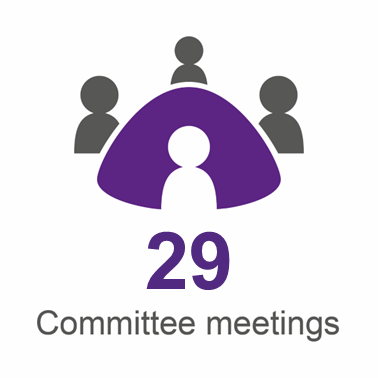
The Committee met 29 times during the parliamentary year. Seven meetings were held entirely in private, 19 meetings included items in private and three meetings were held entirely in public.
The purpose of the private items was for the consideration of evidence heard, agree draft reports, consider draft Standing Order Rule changes, consideration of complaints and agreeing its work programme.
Legislation
Scottish Parliament (Recall and Removal of Members) Bill
The Committee continued its consideration of the Scottish Parliament (Recall and Removal of Members) Bill at Stage 1. We concluded oral evidence on the Bill on 19 June 2025 when we heard from Graham Simpson MSP and published our Stage 1 report on 5 November 2025.
The Committee then considered the Bill at Stage 2 at its meeting on 29 January 2026.
Freedom of Information Reform (Scotland) Bill
The Committee was designated as lead committee for scrutiny of the Freedom of Information Reform (Scotland) Bill, which was introduced by Katy Clark MSP on 2 June 2025.
The Bill aims to address recommendations made by the Session 5 Public Audit and Post-legislative Scrutiny Committee following its post-legislative scrutiny inquiry into the operation and effectiveness of the Freedom of Information (Scotland) Act 2001. Measures proposed in the Bill include introducing a new mechanism by which additional bodies may be designated under the FoI Act, requiring pro-active publication of information, requiring an FoI officer to be designated in each public authority and changes to the enforcement powers of the Scottish Information Commissioner.
The Committee issued a call for views on the Bill on 19 September 2025 and received 108 responses. The Committee took oral evidence on the Bill at four meetings during November 2025 , concluding on 27 November 2025 when it heard from Katy Clark MSP. The Committee's report on the Bill at Stage 1 was published on 26 January 2026.
Following the Parliament's agreement to the general principles of the Bill, the Committee wrote to Katy Clark MSP asking for a response to the Committee's report and how she intended to approach the development of any amendments at Stage 2. We also noted that the Committee's first opportunity to consider the Bill at Stage 2 would be on 12 March due to the minimum periods between stages of Bills that are set out in Standing Orders. The Committee also wrote to the Bureau to confirm that it had sought this information.
Katy Clark MSP responded to the Committee on 2 March 2026. In that letter Katy Clark noted that "the limited time remaining in this parliamentary session means that Stage 2 is unlikely to take place".
Subordinate legislation

During this reporting period, the Committee considered 17 Scottish statutory instruments (SSIs) of which eleven were considered under the affirmative procedure and six under the negative procedure.
The SSIs considered by the Committee this year included the Scottish Parliament (Constituencies and Regions) Order 2025, which reflected the recommendations arising from Boundaries Scotland's report to Scottish Ministers on the second review of Scottish Parliament Boundaries and the Scottish Parliament (Elections etc.) (Miscellaneous Amendments) Order 2025, which makes provision for the conduct of the Scottish Parliamentary election in May 2026.
LCMs
At its meeting on 19 June 2025, the Committee considered a legislative consent memorandum in relation to the Absent Voting (Elections in Scotland and Wales) Bill
At its meeting on 12 March 2026, the Committee considered a legislative consent memorandum in relation to the Representation of the People Bill.
Inquiries/case studies
Committee Effectiveness Inquiry
During the course of the committee effectiveness inquiry the Committee sought to demonstrate the range of tools and approaches open to committees to deliver an inquiry in as effective a manner as possible. This included building in time to scope out the Committee’s work with a deliberative discussion session between Members, facilitated by the Scottish Parliament Information Centre and the Participation and Communities Team and the appointment of a committee adviser to provide a useful external perspective and ‘critical friend’ role.
On 2 October 2025 the Committee published its inquiry report Strengthening committees’ effectiveness.
The report identifies a series of conclusions and practical recommendations to enhance and improve the performance of committees. These include recommendations regarding:
The role of committee members in promoting effective working on committees, including the importance of collegiate working; training and support for committee members; committees being required to set objectives for individual pieces of scrutiny and inquiry work.
Reducing the size of committees from a maximum number of fifteen to ten members and that committees should normally have a maximum of seven members.
No single sex committees next parliamentary session and that when committees are established there is a requirement placed on the Parliamentary Bureau for their proposals for members of each committee to normally reflect the gender balance of the whole Parliament.
The role of conveners in promoting committee effectiveness and providing an opportunity for the Parliament to consider proposals for committee conveners to be elected by the Parliament.
The capacity of committees within their workloads to engage in good scrutiny work, including allocating more time in parliamentary week to committees and establishing more time-limited committees to respond to high profile issues that cut across remits, or to conduct work on specific areas of post-legislative scrutiny.
The role committee stakeholders and the public can play in helping to ensure that committees deliver effective scrutiny.
How the effectiveness of committees is evaluated including creating a requirement that committee annual reports set out how effectively the committee has conducted its scrutiny and what it has achieved;
In November 2025 the Parliament debated the report and welcomed its conclusions and recommendations.
The Committee then published Standing Order rule changes reports to give effect to the inquiry report recommendations.
A Parliament for All: Report of the Parliament’s Gender Sensitive Audit
On 28 January 2026 the Committee published its report on proposed Standing Order rule changes relating to recommendations in the report of the Gender Sensitive Audit regarding membership of the Parliamentary Bureau, Election of Presiding Officer/Deputy Presiding Officer and Membership of the Scottish Parliamentary Corporate Body.
As a Committee we recognise the importance of having a ‘gender sensitive parliament’ where equality exists between men and women in relation to both representation and participation in the Parliament. We are keen to ensure that progress is made towards its delivery.
We considered the Audit recommendations within the context of potential rule changes to Standing Orders, their practical application and operation and also to give consideration to whether there are any potential unforeseen consequences.
In our report we have recommended strengthening the wording of the relevant Standing Order rules to increase the prospect of gender balance on the Bureau and Corporate Body. The Committee has also agreed to recommend changes to Standing Orders to give effect to the Audit’s proposals that there should be a formal quota for Presiding Officer/Deputy Presiding Officer – at least one man and one woman.
It is expected that these proposed changes will be considered by the Parliament before the end of the Parliamentary session. If agreed to they would take effect from the start of Session 7.
Standing Order rule changes – Miscellaneous and minor amendments
The Committee received several requests for miscellaneous and minor rule changes to be made to Standing Orders to take effect from the start of the next Parliamentary session. Requests included removal of references to the EU as they were no longer applicable to the Scottish Parliament in the post-EU context and a series of rule changes to bring rules into line with long-established practice, clarify rules that are open to conflicting interpretations, and delete rules that are no longer required.
The Committee considered these requests and agreed to recommend to Parliament changes to Standing Orders.
Cross-Party Groups

No new Cross-Party Groups (CPGs) were accorded recognition in this parliamentary year. The CPG on Improving Scotland’s Health disbanded at the request of the Conveners and the Committee agreed to a request from the CPG on Deafness to change its purpose to include deafblindness.
The Committee also considered two complaints about CPGs during this year. In one case the Committee found that there had been a breach of the Code and wrote to the Co-Conveners of the Group to remind them of the obligation to comply with the requirements of the Code of Conduct. In the other case, the Committee found that there had not been a breach of the Code.
During this parliamentary year, the Committee consulted MSPs on proposed changes to the Code of Conduct in relation to CPGs. The changes proposed related to a range of matters regarding CPGs, including proposed limits of the number of CPGs of which each MSP can be a member or office bearer. Other proposed changes would ensure that the Committee is able to establish a clearer picture of CPGs' compliance with the Code. The Committee's proposals were supported by the MSPs who responded to the survey and it is anticipated that changes to the Code will be implemented from the start of Session 7.
At its meeting on 5 March 2026, the Committee considered CPGs' compliance with the Code of Conduct and agreed to withdraw recognition from ten CPGs. At the end of this parliamentary year, there were a total of 93 CPGs with recognition.
Parliamentary Corporation Supported Bodies
Under the Parliament's Standing Orders, the annual reports or strategic plans of supported bodies are to be referred to the Committee within whose remit the subject matter of that document falls for consideration.
The Committee took evidence from David Hamilton, the Scottish Information Commissioner on his annual report on 26 February 2026.
The Committee took evidence from the Ian Bruce, Commissioner for Ethical Standards in Public Life in Scotland on his annual report on 5 March 2026.
Complaints
The Committee considered and reported on one report from the Commissioner for Ethical Standards in Public Life in Scotland about a complaint about an MSP under the Code of Conduct.
Equal opportunities
The Committee’s main area of interest in relation to its work and equal opportunities has been consideration of the recommendations in the Parliament’s Gender Sensitive Audit. As detailed elsewhere in this annual report following consideration of the Audit the Committee has brought forward proposals for Standing Order rule changes for the Parliament to agree.
The Committee also considered equal opportunities within its scrutiny of the Scottish Parliament (Recall and Removal of Members) Bill, particularly in relation to the proposals contained in the Bill as introduced relating to physical attendance requirements hearing evidence in relation to the greater impact this could have on MSPs with certain characteristics or backgrounds, including women, minorities, and those with disabilities, caring responsibilities, health conditions, or financial difficulties.